
No will, Young Children, and an Estate to Sort Out: What Happens in Northern Ireland?
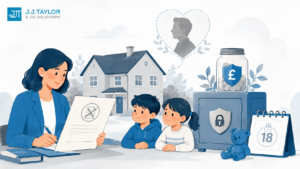
When someone dies without leaving a Will, the law decides who inherits.
That may sound simple enough. It is not.
It becomes even more awkward when children are involved, especially young children. Families often assume that “it will all just go to the children” or that the surviving parent can simply deal with everything. Sometimes that is broadly true. Often, it is much messier than expected.
In Northern Ireland, if someone dies without a valid Will, they are said to have died intestate. Their estate must then be dealt with under the intestacy rules. These rules decide:
- who is entitled to apply to deal with the estate;
- who inherits the estate;
- When children receive money;
- who holds money for children until they are old enough; and
- What happens if there are conflicts or practical difficulties?
This article explains the basics in plain English.
First: No will means no executor.
If there is a Will, the Will usually names one or more executors. These are the people the deceased chose to handle the estate.
If there is no Will, there is no executor.
Instead, someone must apply to become the administrator of the estate. The official court document is called a Grant of Letters of Administration. This gives the administrator legal authority to collect the assets, pay debts, deal with banks and institutions, and distribute the estate to the correct beneficiaries.
That is one of the first problems with dying without a Will. Nobody has been clearly chosen. The law has to step in and work out who has the right to apply.
Who can apply to administer the estate?
In Northern Ireland, there is an order of priority for who can apply for Letters of Administration where there is no Will.
Broadly, the order starts with:
- the spouse or civil partner;
- the children of the deceased;
- grandchildren, if their parent has already died;
- parents;
- brothers and sisters, including half-brothers and half-sisters;
- more remote relatives.
A long-term unmarried partner does not automatically have the same rights as a spouse or civil partner. That can come as a nasty shock.
So, for example, if a couple lived together for 25 years, had children together, shared a home, and everyone regarded them as “basically married”, that does not make them married in law. If there is no Will, the intestacy rules still apply.
This is one of the big reasons why making a Will matters. It lets you choose who deals with your estate, instead of leaving your family to work through the statutory order after your death.
What do the children inherit?
The answer depends on who survives the deceased.
If the deceased leaves a spouse or civil partner, that spouse or civil partner may be entitled to part of the estate, with the children entitled to the remainder depending on the value and circumstances.
If there is no surviving spouse or civil partner, the children will usually inherit the estate equally.
If one of the deceased’s children has already died, leaving children of their own, those grandchildren could inherit the share their parent would have received.
This is sometimes called ” inheriting by representation”. In plain English, the branch of the family does not necessarily lose out just because one child died before the parent.
For example:
Mary dies without a Will. She had three children: Anna, Brian and Claire. Brian died before Mary, leaving two children of his own.
Mary’s estate may be divided into three shares. Anna receives one share. Claire receives one share. Brian’s share is divided between his two children.
Again, that may sound straightforward on paper. In real life, it can become difficult very quickly, particularly where beneficiaries are under 18.
What is a statutory intestacy trust?
Where a child inherits under the intestacy rules but is still under 18, they usually cannot simply receive the money outright.
A child cannot give a valid receipt in the same way an adult beneficiary can. They cannot sensibly be handed a large inheritance at age 6, 10 or 15 and told to look after it.
Instead, the child’s share is held in a trust commonly called a statutory intestacy trust.
That means the money or assets are held by adults for the child until the child becomes entitled to receive them. In general terms, the child becomes entitled at 18, or earlier if the statutory conditions are met.
The important point is this: the child owns the benefit of the inheritance, but they do not usually control it while they are still a minor.
Who looks after the child’s money?
The money is usually held by the administrators or trustees.
Their job is not to treat the money as their own. Their job is to protect it for the child.
They may need to:
- open an appropriate account;
- keep clear records;
- invest or hold funds responsibly;
- make decisions about whether funds should be used for the child’s benefit;
- account for what has happened to the money; and
- eventually transfer the money to the child when the child becomes entitled to it.
This is where families sometimes get into trouble.
A surviving parent may assume, “Well, I’m the parent, so I can use the money as I think best.” That is not always safe. Money inherited by a child belongs beneficially to that child. It is not a general family pot. It is not automatically the surviving parent’s money. It is not to be quietly absorbed into day-to-day household spending without proper thought and record-keeping.
That does not mean money can never be used for a child’s benefit. But it does mean the person holding it must be careful. They should keep records and take advice where necessary.
When might money be held for children?
This can arise in several common situations.
The most obvious is where a parent dies without a Will and leaves young children.
It can also arise where a grandparent dies without a Will and a child of the grandparent has already died, meaning the deceased child’s own children inherit their parent’s share.
It may also arise where an estate is partly intestate. That means there is a Will, but it does not properly deal with all of the estate. The part not dealt with by the Will may then pass under the intestacy rules.
Minor beneficiaries can also be relevant where life policies, pension nominations, jointly owned assets or other arrangements sit alongside the estate. These need to be checked carefully because not every asset passes through the estate in the same way.
For example, jointly owned property may pass automatically to the survivor depending on how it is owned. Pension death benefits may be dealt with by pension trustees rather than under the Will or intestacy rules. Life policies may or may not form part of the estate depending on how they were set up.
So the first job is always to work out what actually forms part of the estate.
Why is this messier than people expect?
Because the law is trying to impose a structure after the event.
With a properly drafted Will, the deceased can say:
- Who should be the executor;
- who should inherit;
- whether children should inherit at 18, 21, 25 or another age;
- who should act as trustees;
- who should act as guardians;
- What powers the trustees should have;
- whether money can be used for education, housing or maintenance;
- What should happen if a beneficiary dies before them;
- What should happen with personal items, property and family assets?
Without a Will, those choices have not been made.
That leaves the family dealing with a rigid legal framework at the worst possible time.
It can create problems such as:
- uncertainty over who should apply for Letters of Administration;
- disagreements between relatives of equal entitlement;
- difficulty dealing with banks, property or shares;
- money having to be held for children for years;
- lack of clear trustees chosen by the deceased;
- no tailored instructions about when children should inherit;
- No guardians appointed in the Will;
- awkward blended family situations;
- unmarried partners are being left in a very difficult position;
- Stepchildren are excluded unless legally adopted.
That last point is worth stressing. Many people regard stepchildren as their children in every meaningful family sense. But intestacy law does not simply treat a stepchild the same as a biological or adopted child.
If you want a stepchild to inherit, you should make a Will.
Example: unmarried parent with young children
Take a simple example.
A father dies without a Will. He was not married or in a civil partnership. He leaves two children, aged 8 and 11. He has a house in his sole name, some savings and a car.
Because there is no spouse or civil partner, the children may be entitled to the estate in equal shares.
But they are minors. They cannot administer the estate themselves. They cannot simply receive the money directly. Someone suitable must apply for Letters of Administration, and the children’s inheritance will need to be held for them.
If the house needs to be sold, legal authority will be needed. If money is released, it must be protected. If funds are needed for the children before they reach 18, that must be handled properly.
This is not necessarily impossible. But it is not as clean as many families expect.
Example: married parent with children
Now take another example.
A married parent dies without a Will, leaving a spouse and two young children.
The spouse may have priority to apply for Letters of Administration. The spouse may also be entitled to part of the estate under the intestacy rules, with the children entitled to a share depending on the size and structure of the estate.
If the children are entitled to part of the estate, their shares may still have to be held for them until they are old enough.
The surviving spouse may therefore be dealing with two roles at once: grieving spouse and administrator/trustee. That can be emotionally and practically difficult, particularly when a family home, mortgage, business, farm, or other major asset is involved.
A Will is usually far cleaner.
A Will does not make death easy. Nothing does.
But it can make the legal aftermath much cleaner.
A properly drafted Will allows you to choose trusted people to act as executors and trustees. It allows you to say who should inherit and at what age. It allows you to make sensible provision for children. It allows you to deal with unmarried partners, stepchildren, second marriages, family homes, farms, businesses and personal possessions.
It also reduces the risk that relatives will have to guess what you would have wanted.
That is the real value of a Will. It isn’t just a document for tax planning or elderly people. It is a set of instructions for the people left behind.
If you have young children, a Will is not a luxury. It is basic housekeeping.
The practical takeaway
If someone has died without a Will and children are involved, the estate needs to be handled carefully.
The key questions are:
- Who is entitled to apply for Letters of Administration?
- Who inherits under the intestacy rules?
- Are any beneficiaries under 18?
- Who will hold the children’s money?
- What assets actually form part of the estate?
- Is there property, land, a business, a pension or a life policy involved?
- Are there family tensions or blended family issues?
- Is legal advice needed before distributing the money?
The earlier these questions are addressed, the less likely the estate is to go wrong.
At J. J. Taylor & Co Solicitors, we help families across Northern Ireland deal with estates where there is no Will, including cases involving young children, statutory trusts and awkward family arrangements.
We also prepare Wills for parents who want to make sure their children are properly protected and that the right people are chosen to deal with things after their death.
If you need advice about an estate, intestacy, Letters of Administration or making a Will, contact us on 028 3752 5400 or email [email protected].
The NI Direct government service provides further guidance on what happens if you die without a Will in Northern Ireland.
For guidance on intestacy Northern Ireland rules and protecting your children, please contact J.J. Taylor & Co Solicitors. We act for families across Armagh, County Down and County Tyrone.